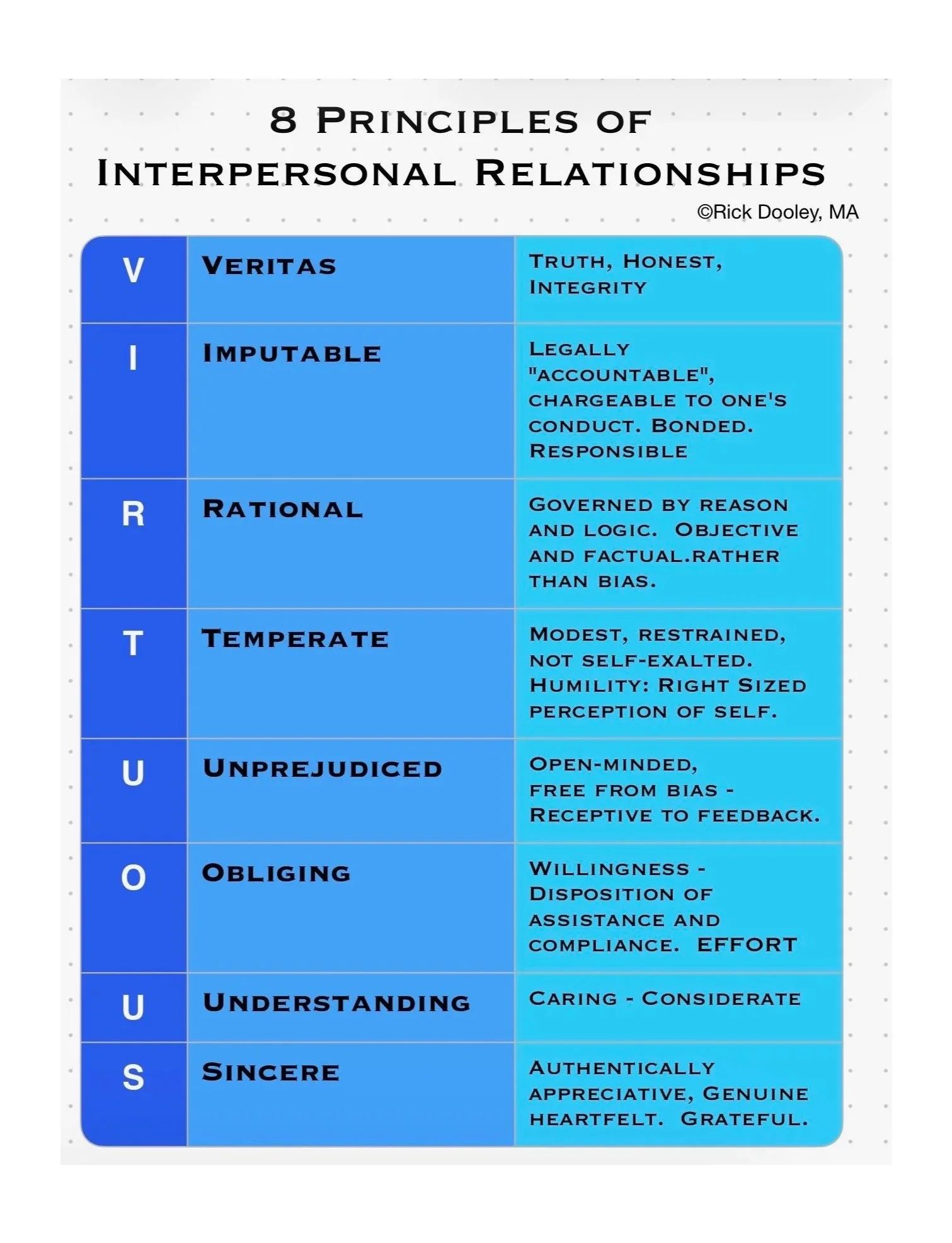
8 Principles of Healthy Relationships #1 Veritas
We all want better relationships.
We want stronger marriages, healthier families, more meaningful friendships, and churches where people genuinely care for one another. Yet many of us spend our energy wishing other people would change while neglecting the one person we actually have responsibility over: ourselves.
Healthy relationships don't begin by fixing everyone else. They begin by asking, "What kind of person am I becoming?"
The first principle in building stronger relationships is one simple word:
Veritas.
The Latin word veritas means truth. But it isn't merely about avoiding lies. It's about living a life characterized by honesty, integrity, and sincerity.
Truth Is More Than Telling the Truth
Most people would quickly agree that lying is wrong. But living truthfully goes much deeper than simply avoiding false statements.
Truthfulness means:
* Keeping your word.
* Being honest about your strengths and weaknesses.
* Speaking difficult truths with love.
* Refusing to manipulate others.
* Living consistently so your actions match your words.
Truth becomes a lifestyle rather than simply an occasional decision.
When people know that your "yes" means yes and your "no" means no, relationships become deeper because trust has a chance to grow.
The Problem Isn't Usually Dishonesty—It's Self-Protection
Most of us don't lie because we enjoy deception.
We distort the truth because we're trying to protect something.
Sometimes we're protecting our image.
Sometimes we're trying to avoid conflict.
Sometimes we're people-pleasing.
Sometimes we're afraid that telling the truth will cost us someone's approval.
Ironically, the very thing we think will preserve the relationship often slowly destroys it.
People cannot build deep trust with someone they never know is being completely honest.
Honesty Is Not Brutal Honesty
Of course, honesty is not an excuse to say everything that comes into your mind.
There is a significant difference between:
* speaking the truth for someone else's good, and
speaking your opinion because it makes you* feel better.
One helpful question to ask before speaking is:
> Am I saying this because it benefits me, or because it benefits them?
If you're excited to "finally tell someone off," you're probably not motivated by love.
If speaking the truth grieves you because you genuinely care for them, you're much closer to biblical truth-telling.
Scripture consistently calls believers to "speak the truth in love" (Ephesians 4:15), not simply to speak whatever comes to mind.
Integrity Holds Weight
One of the most powerful ideas is this:
Integrity holds weight.
Think about a bridge.
A bridge with structural integrity can carry enormous loads because people trust it.
Without integrity, it eventually collapses.
The same is true of our lives.
When people know that your character is solid, they'll entrust you with greater responsibility.
Leadership depends upon integrity.
Parents need it.
Pastors need it.
Friends need it.
Counselors need it.
If your words consistently match your actions, people begin to trust not merely what you say—but who you are.
Trust Is Often a Response
We often hear people say, "Just trust me."
But trust is rarely created by a command.
More often, trust is a response.
When someone consistently tells the truth...
When they keep their commitments...
When they admit when they're wrong...
When they don't manipulate...
People naturally begin to trust them.
Integrity creates an environment where trust can flourish.
Even Small Acts Build Credibility
Many people think integrity requires dramatic moments of heroism.
Usually, it begins much smaller.
"I'll call you tomorrow."
Then call.
"I'll be there at five."
Then show up.
"I'll pray for you."
Then actually pray.
Every kept promise deposits another small amount into the bank account of trust.
Likewise, every broken promise makes a withdrawal.
Over time, those small moments shape the reputation we carry.
One of the Greatest Lies We Believe
Many people eventually stop trusting themselves.
They repeatedly promise they'll change...
...and repeatedly fail to follow through.
Eventually they conclude:
> "I guess this is just who I am."
But that's not truth.
The truth found in Scripture is that believers are being transformed by the power of Christ.
God doesn't define us by our failures.
He defines us by our union with Christ and calls us to continual growth.
Truth isn't merely about speaking honestly to others.
It's also about believing what God says about us.
A Simple Way to Practice Veritas Today
If you want to grow in integrity, don't start with something enormous.
Start small.
Choose one commitment today and keep it.
Tell one difficult truth kindly.
Give one sincere compliment you've been withholding.
Admit one mistake instead of making an excuse.
Each small act strengthens the habit of integrity.
And each act makes you a little more trustworthy tomorrow than you are today.
Final Thought
Healthy relationships aren't built on perfection.
They're built on truth.
Truth may be uncomfortable in the moment, but it creates the kind of trust that allows relationships to flourish over time.
As the Apostle Paul writes:
> "Therefore, having put away falsehood, let each one of you speak the truth with his neighbor, for we are members one of another." — Ephesians 4:25
Veritas isn't simply about avoiding lies.
It's about becoming the kind of person whose life is so marked by integrity that others know they can trust your words, your character, and ultimately, your walk with Christ.