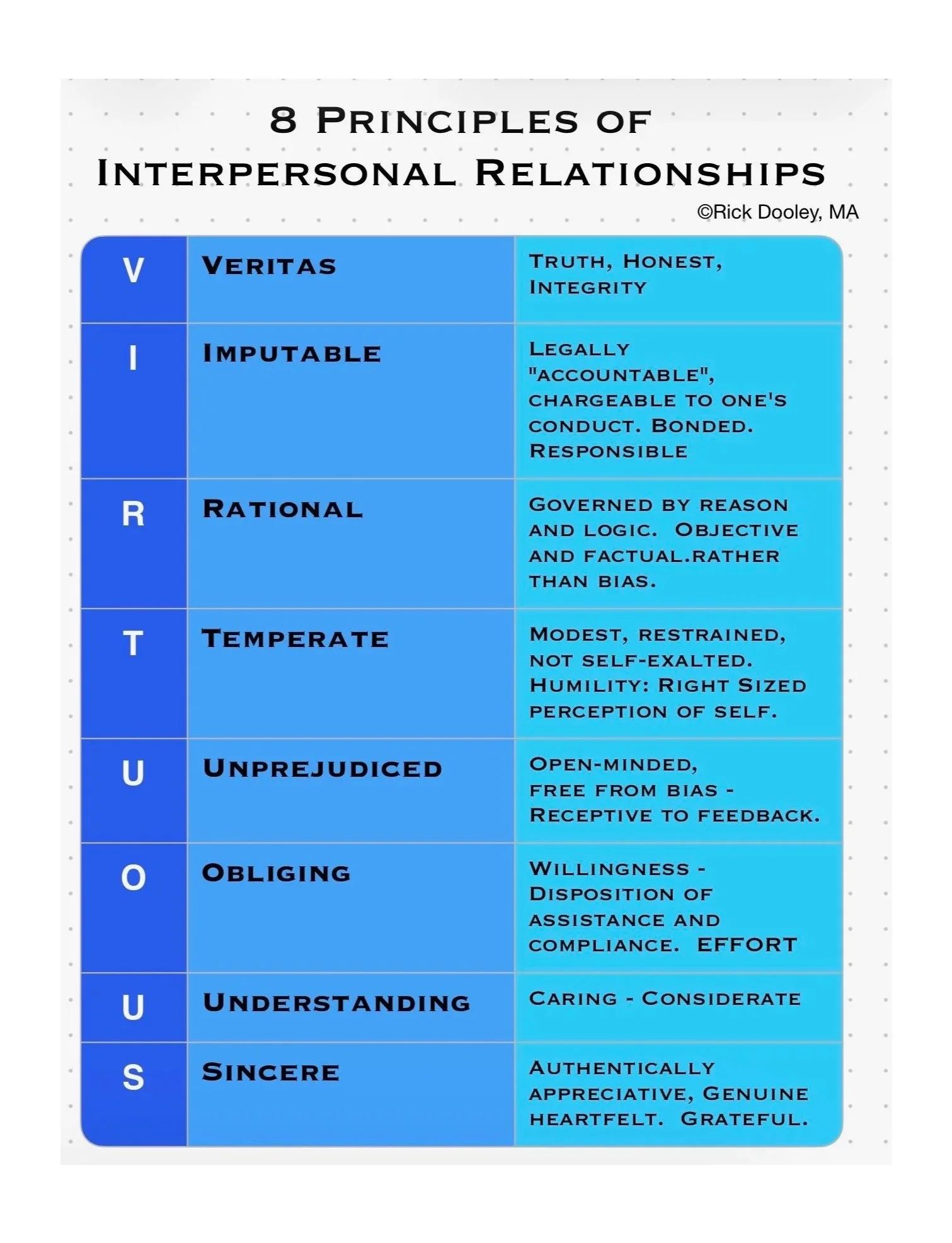
8 Principles of Healthy Relationships #2 Imputable
Imputable: Why Taking Responsibility Changes Everything
The second principle in our series on building healthier relationships.
If truth is the foundation of healthy relationships, responsibility is the first brick you lay on that foundation.
In the first article of this series, we explored Veritas—living a life marked by truth, integrity, and sincerity. Truth is the bedrock upon which every healthy relationship is built.
But truth inevitably leads us to another question:
Now that I know the truth, what am I going to do with it?
The answer is found in the second principle:
Imputable.
It's not a word most people use, but it captures something desperately needed in our culture.
An imputable person is someone who willingly accepts responsibility for their choices, actions, attitudes, and influence.
Instead of asking, "Who's to blame?" they ask,
"What is my responsibility here?"
That one question has the power to transform marriages, friendships, churches, workplaces, and even your relationship with God.
Responsibility Is the Opposite of Victimhood
One of the defining characteristics of our culture is the tendency to explain everything without taking ownership of anything.
Someone else caused it.
Society is responsible.
Our parents are responsible.
Our spouse is responsible.
Our church is responsible.
Our government is responsible.
Sometimes those explanations contain genuine truth. People really are wounded. Injustice really exists. Circumstances really shape us.
But explanations are not the same thing as responsibility.
Healthy people acknowledge their circumstances while refusing to surrender their agency.
They ask,
"Given what's happened to me, what does God call me to do now?"
That question moves us from helplessness to faithfulness.
Responsibility Begins with Truth
This is why Veritas comes first.
Without truth, responsibility becomes distorted.
Some people only take credit for the good things.
Others only blame themselves for the bad things.
Neither response is truthful.
Truth allows us to see ourselves accurately.
It lets us say:
I succeeded here.
I failed here.
I need help here.
I can grow here.
Real responsibility requires honest self-assessment.
The Biblical Call to Bear Responsibility
Jesus never called His followers to passive Christianity.
Instead, He said:
"If anyone would come after me, let him deny himself and take up his cross daily and follow me." (Luke 9:23)
Taking up your cross is an act of responsibility.
It means choosing obedience when obedience is costly.
It means refusing to blame everyone else for your spiritual condition.
It means actively participating in the work God is doing in your life.
Grace does not eliminate responsibility.
Grace empowers it.
What Does "Deny Yourself" Actually Mean?
Many people misunderstand self-denial.
It does not mean pretending you don't have emotions.
It does not mean ignoring your personality.
It does not mean acting as though your struggles aren't real.
Instead, denying yourself means refusing to let your preferences become your master.
It means acknowledging your desires while placing them under the authority of Christ.
Ironically, you can't deny yourself unless you're honest about yourself.
That's another reason truth comes first.
Responsible To People, Not Responsible For Them
One of the healthiest distinctions we can make is this:
We are responsible to people, but we are not responsible for people.
That single word—to—changes everything.
As Christians, we bear one another's burdens.
We encourage.
We correct.
We restore.
We pray.
We serve.
But we cannot make another person repent.
We cannot force someone to change.
We cannot carry responsibilities God has assigned to them.
Healthy relationships require healthy boundaries.
Otherwise, responsibility turns into control.
Or, on the opposite extreme, compassion turns into enabling.
Galatians 6 Holds Both Truths Together
Paul writes:
"Brothers, if anyone is caught in any transgression, you who are spiritual should restore him in a spirit of gentleness... Bear one another's burdens, and so fulfill the law of Christ." (Galatians 6:1–2)
Notice something remarkable.
Before Paul tells believers to help others, he says:
"Keep watch on yourself, lest you too be tempted."
Why?
Because helping someone else can become another form of self-centeredness.
We begin defining ourselves by fixing people.
We become controlling.
Obsessive.
Unable to separate our responsibilities from theirs.
Biblical responsibility always begins by watching our own hearts.
Cain Asked the Wrong Question
After Cain murdered Abel, God asked,
"Where is your brother?"
Cain replied,
"Am I my brother's keeper?"
In one sense, the answer is yes.
Cain wasn't responsible for every decision Abel made.
But he certainly was responsible for murdering him.
Instead of admitting his guilt, Cain shifted responsibility.
Blame-shifting has existed since the Garden of Eden.
Taking responsibility is one of the clearest evidences of spiritual maturity.
We Naturally Judge Others Differently Than Ourselves
Psychologists call it the Fundamental Attribution Error.
It's the tendency to explain our own failures by our circumstances while explaining other people's failures by their character.
When I'm late...
Traffic was terrible.
When you're late...
You're irresponsible.
When I lose my temper...
I've been under a lot of stress.
When you lose your temper...
You're immature.
We instinctively grant ourselves complexity while simplifying everyone else.
Responsibility interrupts that pattern.
Instead of asking,
"Why are they like this?"
We begin asking,
"How should I faithfully respond?"
That shift changes relationships.
Everything You Do Matters
Many people live with one of two destructive beliefs.
The first is nihilism:
Nothing matters.
The second is a practical form of determinism:
Everything is already decided, so my choices don't matter.
Scripture rejects both.
Everything matters.
Every conversation.
Every apology.
Every act of obedience.
Every word spoken in love.
Every small decision becomes part of God's work of shaping us into Christ's image.
You may never know how God uses your faithfulness.
But faithfulness is never wasted.
Think of Life Like a Baby Mobile
Imagine the mobile hanging above a baby's crib.
Touch one piece.
Every other piece moves.
Relationships work the same way.
Nothing you do exists in isolation.
Your attitudes affect your family.
Your words affect your church.
Your consistency affects your children.
Your integrity affects your workplace.
Everything is connected.
You cannot change everyone around you.
But when you change how you show up, the entire system begins to move.
Show Up
One of the greatest temptations is believing:
"Nothing I do will make a difference."
That belief keeps people passive.
But Scripture repeatedly calls believers to show up.
Show up in your marriage.
Show up for your children.
Show up in your church.
Show up for difficult conversations.
Show up in prayer.
Show up in obedience.
You may feel inadequate.
So did Moses.
He wasn't a gifted speaker.
Yet God used him to lead an entire nation.
Your usefulness has never depended upon your perfection.
It has always depended upon your willingness to obey.
One Simple Way to Practice Imputability Today
Choose one area of your life where you've been tempted to blame someone else.
Ask yourself:
What part of this situation belongs to me?
What action can I take today?
What responsibility have I avoided?
What excuse have I been making?
Then take one step.
Not ten.
Just one.
Responsibility grows through repeated acts of obedience.
Final Thought
Healthy relationships are built by people who stop asking,
"Whose fault is this?"
and begin asking,
"What has God entrusted to me?"
Truth gives us the courage to see reality.
Responsibility gives us the courage to act.
When those two principles come together, we stop living as passive victims of circumstance and begin living as faithful stewards of the lives God has given us.
We cannot control every outcome.
But we can faithfully show up.
And only God knows what He might do through someone willing to take responsibility for what He has placed in front of them.