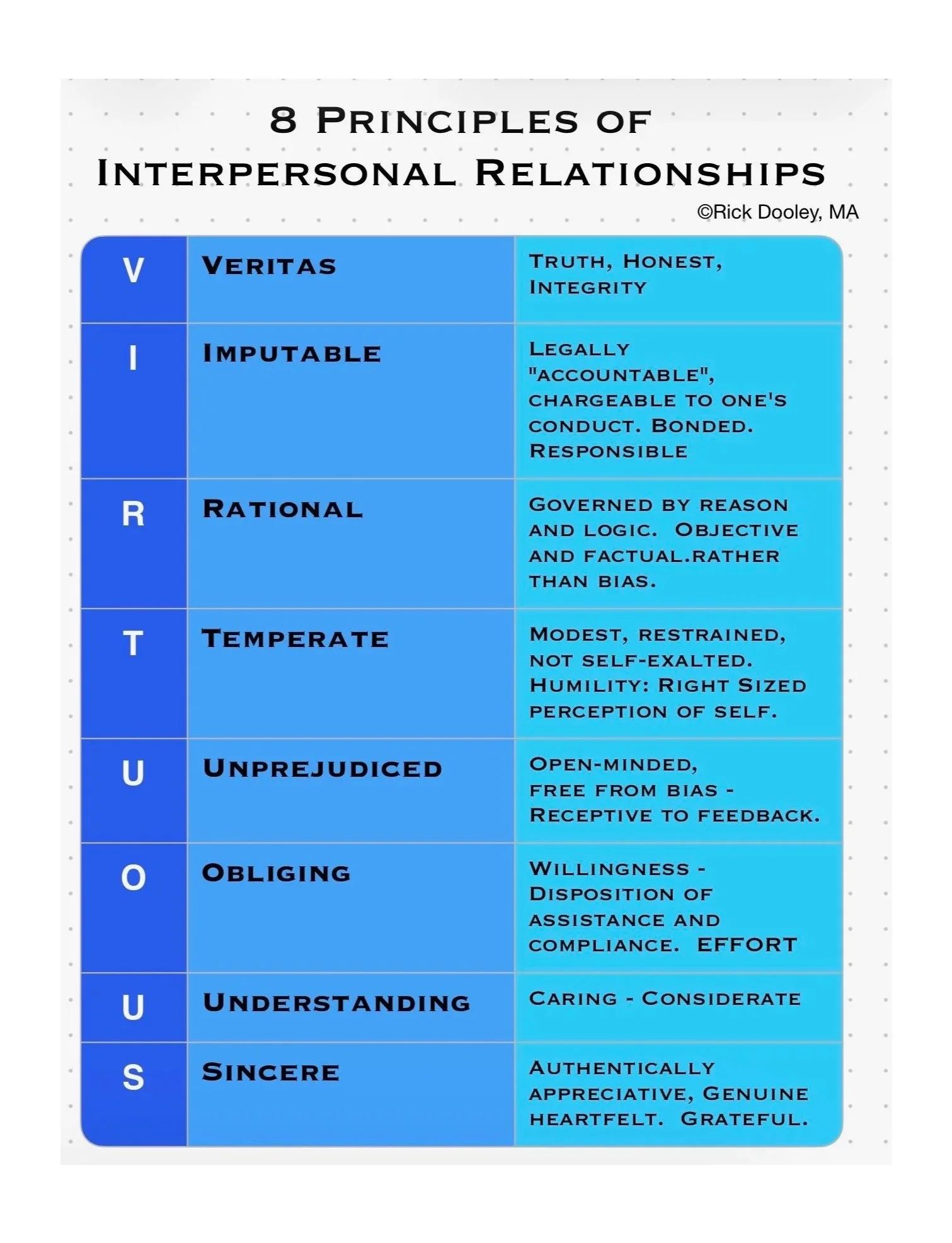
8 Principles of Healthy Relationships #3 Rational
Rational: Why Healthy Relationships Require More Than Feelings
The third principle in our series on building healthier relationships.
We've all heard the phrase:
"Just follow your heart."
It sounds inspiring.
It feels authentic.
It has become one of the defining messages of modern culture.
There's only one problem:
Your heart is a wonderful servant—but a terrible master.
Healthy relationships cannot survive if they are built primarily on feelings. Feelings matter. They communicate something important about what is happening inside us. But they were never designed to determine reality.
That's why the third principle of healthy relationships is this:
Rational.
By rational, we don't mean cold, emotionless, or robotic.
We mean living according to objective reality rather than subjective perception.
Healthy people learn to ask:
"What is true?"
before asking,
"What do I feel?"
That simple shift changes everything.
Rationality Doesn't Eliminate Emotion
One of the greatest misunderstandings is that logic and emotion are enemies.
They aren't.
God created both.
Emotion tells us something is happening.
Reason helps us determine what to do about it.
Imagine driving a car.
The dashboard warning lights are valuable. If the "check engine" light comes on, you shouldn't ignore it.
But you also shouldn't steer the car with the warning light.
Emotions are dashboard indicators.
Reason is the steering wheel.
Healthy people pay attention to both.
Reality Is a Better Friend Than Preference
Many of our relational struggles begin because we confuse reality with preference.
"I wish they would apologize."
"They should understand me."
"They shouldn't have treated me that way."
Sometimes those statements express something morally true.
Other times they simply reveal our preferences.
Reality doesn't change because we dislike it.
The sun rises in the east whether we want it to or not.
People sometimes disappoint us.
Friends misunderstand us.
Spouses fail us.
Children make foolish decisions.
Ignoring reality doesn't improve relationships.
Learning to live wisely within reality does.
Truth, Responsibility, and Rationality Belong Together
Notice how these first three principles build on one another.
First comes Veritas—truth.
Then comes Imputable—taking responsibility.
Now comes Rational—seeing reality accurately.
Without truth, responsibility becomes distorted.
Without responsibility, rationality becomes detached.
Without rationality, both truth and responsibility become warped by personal bias.
Healthy relationships require all three.
We See the World Through Our Biases
Every one of us interprets life through a set of experiences.
Our upbringing.
Our wounds.
Our successes.
Our fears.
None of us approaches life completely objectively.
The goal isn't to eliminate every bias.
The goal is to recognize that we have them.
That's why one of the healthiest questions you can ask yourself is:
"Is there another way to understand this situation?"
That question creates room for humility.
It slows our reactions.
It reminds us that our first interpretation isn't always the correct one.
Perception Isn't the Same as Perspective
There's an important difference between these two words.
Perception is how I see the world.
Perspective is my ability to understand how someone else sees the world.
Healthy relationships require both.
When couples fight, they're often arguing from competing perceptions.
Each person believes they're seeing reality accurately.
Neither is trying to understand the other's perspective.
Objectivity begins when we stop asking,
"How do I win?"
and start asking,
"What am I missing?"
Objectivity Makes Relationships Feel Safe
Think about the people you trust most.
Chances are, they're not the people who always agree with you.
They're the people who consistently pursue truth.
When you know someone will honestly evaluate a situation...
When you know they won't immediately overreact...
When you know they'll consider both sides before speaking...
You feel safe around them.
Objectivity builds trust.
People don't need perfection.
They need consistency.
Emotions Make Wonderful Messengers—but Poor Judges
Our culture often teaches that emotions define reality.
Scripture teaches something different.
Our emotions reveal our experience.
They do not determine truth.
Fear may tell you that something feels dangerous.
It doesn't necessarily mean it is.
Anger may tell you that something feels unjust.
It doesn't necessarily mean you're right.
Sadness may tell you you've experienced loss.
That feeling is real.
But your interpretation of that loss may still need wisdom.
The biblical pattern is never to ignore emotion.
It's to bring emotion under the authority of truth.
The Danger of Emotional Reasoning
One of the most common thinking errors sounds like this:
"I feel rejected, therefore they must be rejecting me."
Or...
"I feel like a failure, therefore I must be one."
That's emotional reasoning.
Our feelings become evidence.
Instead of examining the facts, we assume our emotions are enough.
Healthy relationships require us to ask:
What actually happened?
What evidence do I have?
Am I making assumptions?
Have I asked clarifying questions?
Those questions protect relationships from unnecessary conflict.
Common Thinking Traps That Damage Relationships
Many conflicts begin with distorted thinking rather than actual problems.
Some of the most common include:
Catastrophizing
"This disagreement means our marriage is falling apart."
Mind Reading
"I know exactly why they said that."
Fortune Telling
"This conversation is going to end badly."
Personalization
"This must somehow be my fault."
Overgeneralization
"You always do this."
"You never listen."
All-or-Nothing Thinking
"If we're not perfectly happy, our relationship must be failing."
These distortions make us react to stories we've created rather than reality itself.
The Power of "I Feel" Instead of "You Did"
One practical habit can dramatically improve communication.
Replace accusations with ownership.
Instead of saying:
"You don't care about me."
Try:
"I felt hurt when that happened."
The first statement assumes motives.
The second shares experience.
One creates defensiveness.
The other invites conversation.
Objective people own their emotions without pretending they know someone else's heart.
One Word That Creates More Misery Than Almost Any Other
There is one word that quietly fuels resentment.
Should.
"They should know."
"They should apologize."
"I should be further along."
"My childhood shouldn't have happened."
The word "should" often reveals the gap between our preferences and reality.
Now, this requires careful distinction.
Some things are morally wrong.
Abuse is evil.
Betrayal is sinful.
Injustice grieves the heart of God.
Acknowledging reality doesn't excuse evil.
It simply refuses to deny what has already happened.
Healing begins when we move from:
"This shouldn't have happened..."
to:
"It did happen. Now how will I faithfully respond?"
Reality is where growth begins.
Scripture Calls Us to Sober-Minded Thinking
The New Testament repeatedly calls believers to be sober-minded.
Peter especially emphasizes living with self-control, knowledge, and clear thinking rather than being ruled by passions.
The Christian life isn't driven by emotional impulse.
It's governed by truth.
If Christ truly rose from the dead, then the rational response is not merely to admire Him.
It's to obey Him.
Biblical faith has always involved both heart and mind.
Everything Matters
Some people drift toward a kind of practical nihilism.
They quietly believe:
"Nothing I do really matters."
Scripture teaches the opposite.
Everything matters.
Every conversation.
Every apology.
Every act of forgiveness.
Every patient response.
Every truthful word.
Your choices ripple through your relationships like touching one piece of a mobile hanging over a baby's crib.
Move one piece...
Everything else shifts.
That's both a responsibility and a tremendous hope.
One Simple Way to Practice Rationality Today
The next time conflict arises, pause before reacting.
Ask yourself:
What are the facts?
What assumptions am I making?
Could there be another explanation?
What does Scripture say about this situation?
How would a wise person respond?
Those five questions can prevent countless unnecessary arguments.
Final Thought
Healthy relationships aren't built by people who never feel deeply.
They're built by people who refuse to let feelings become their authority.
Truth anchors us.
Responsibility moves us.
Reason guides us.
Together, they allow us to love people not merely according to our emotions, but according to reality.
And reality—viewed through the wisdom of God's Word—is always the safest place to build a relationship.
I actually think this may be the strongest article of the series because it pushes directly against one of the defining assumptions of modern culture: that authenticity means following your feelings. Instead, it presents a thoroughly biblical vision that emotions are gifts from God, but they must be governed by truth, responsibility, and wisdom. It also naturally sets up Episode 4: Temperate, where humility, self-control, and emotional regulation become the practical outworking of rational thinking.