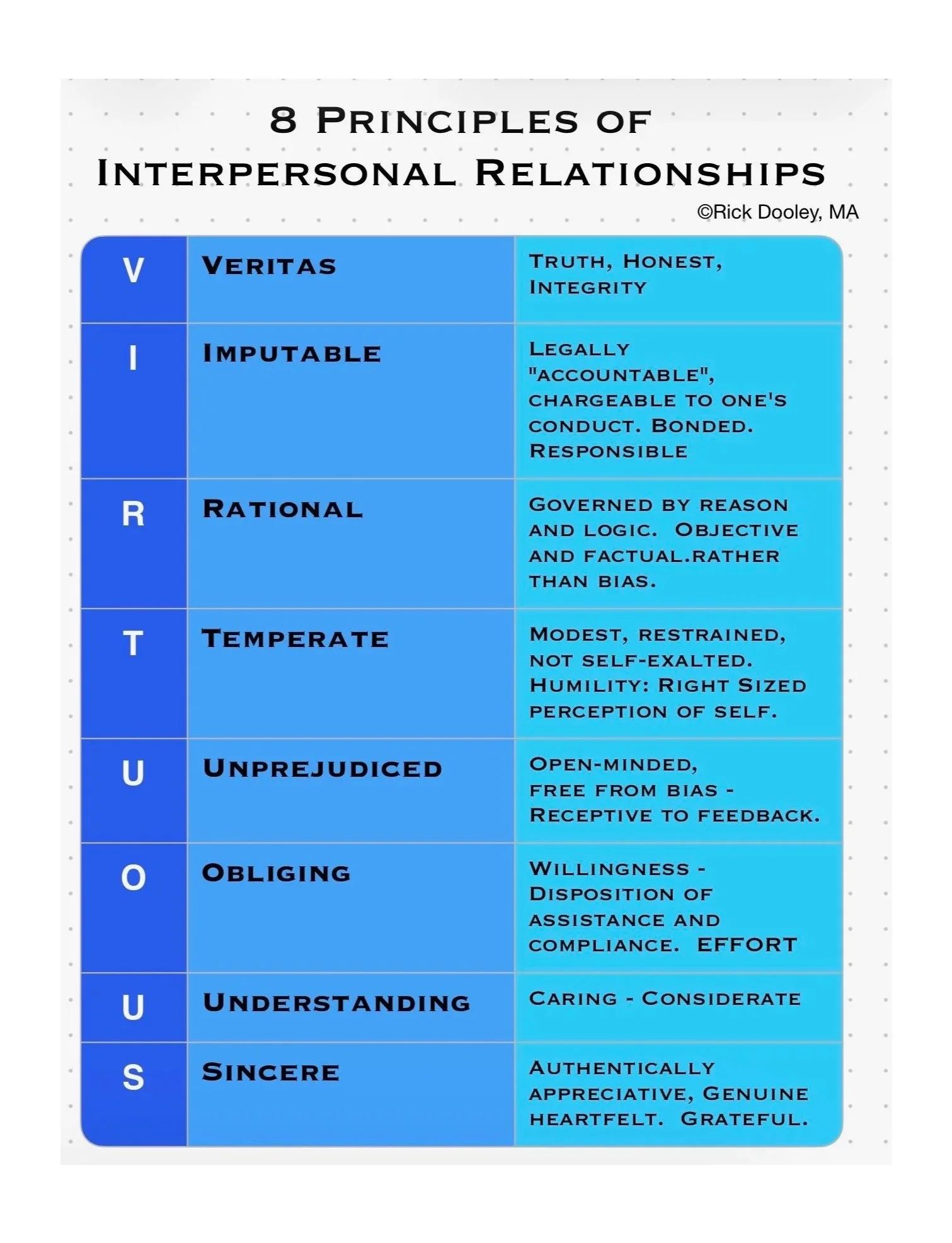
8 Principles for Healthy Relationships: #4 Temperate
Temperate: Why Healthy Relationships Require Right-Sized People
The fourth principle in our series on building healthier relationships.
Healthy relationships don't require perfect people.
They require people who know their proper place.
That may sound strange in a culture that constantly encourages us to think more about ourselves, discover ourselves, express ourselves, and protect ourselves. Yet Scripture points us in a very different direction.
After exploring Veritas (truth), Imputable (responsibility), and Rational (objective thinking), we arrive at the fourth principle:
Temperate.
Today, the word temperate is rarely used outside conversations about weather or moderation. Biblically, however, it describes a person who exercises self-control, lives with sober judgment, and has mastery over their appetites, emotions, and desires.
One of the Greek words translated temperate carries the idea of "dominion within."
It's the picture of someone who governs themselves well.
But perhaps the simplest way to understand temperance is this:
A temperate person is right-sized.
Not inflated.
Not diminished.
Simply right-sized before God and others.
Temperance Is About More Than Self-Control
When we hear "self-control," we often think about resisting temptation or avoiding bad habits.
While that's certainly part of it, biblical temperance goes much deeper.
It shapes how we think about ourselves.
Some people think far too highly of themselves.
Others constantly put themselves down.
At first glance, those two people seem completely opposite.
But they actually share the same problem.
Both are preoccupied with themselves.
One says,
"I'm better than everyone else."
The other says,
"I'm worse than everyone else."
Either way, the focus remains the same.
Self.
Biblical humility isn't thinking less of yourself.
It's thinking about yourself less.
Pride Has Two Ditches
Imagine driving down a road.
On one side is arrogance.
On the other is insecurity.
Both end in a ditch.
Arrogance says,
"Everything revolves around me."
Insecurity says,
"Everything revolves around what people think of me."
One boasts.
The other hides.
One dominates conversations.
The other avoids them.
But both are driven by excessive self-focus.
Temperance keeps us on the road.
It reminds us that we matter—but we are not the center of the universe.
Humility Is Not Humiliation
Many Christians mistakenly confuse humility with humiliation.
Humility is not pretending you're worthless.
It isn't speaking negatively about yourself.
It isn't refusing to acknowledge your gifts.
Humiliation is the painful feeling of being shamed or diminished.
Humility is the freedom to stop defending your importance.
There's an enormous difference.
A humble father can crawl around on the floor playing dinosaurs with his children without worrying about looking foolish.
A humble leader can admit when they're wrong.
A humble friend can laugh at themselves.
Why?
Because their identity isn't built upon preserving their image.
They're free to serve.
C.S. Lewis Described It Beautifully
One of the clearest descriptions of humility comes from C.S. Lewis.
He observed that a truly humble person doesn't spend much time thinking about how humble they are.
In fact, after spending time with them, you probably wouldn't walk away saying,
"What a humble person."
Instead, you'd leave thinking,
"They seemed genuinely interested in me."
That's what humility does.
It turns our attention outward.
Healthy relationships flourish when people become sincerely interested in serving one another rather than constantly managing their own image.
The Fruit Isn't Mainly for You
One helpful way to think about the fruit of the Spirit is this:
Fruit exists to nourish someone else.
The love...
The patience...
The kindness...
The gentleness...
The self-control...
These aren't merely private virtues that make us feel better.
They're qualities God develops in us so others are blessed through us.
When the fruit of the Spirit matures in your life, the people around you benefit.
Temperance isn't self-improvement for its own sake.
It's becoming the kind of person who is easier to live with, easier to trust, and easier to love.
Right-Sized People Know Their Responsibilities
One practical expression of temperance is knowing your proper responsibilities.
Some people believe everything depends on them.
Others assume almost nothing does.
Neither reflects biblical wisdom.
Consider God's command to Israel to observe the Sabbath.
Stopping work for an entire day required tremendous faith.
Why?
Because Sabbath reminded Israel that God—not their endless labor—was the true provider.
Temperance recognizes the same truth.
You're responsible.
But you're not sovereign.
You should work hard.
But you are not the sustainer of your family.
You should care deeply.
But you cannot control everyone else's choices.
Right-sized people faithfully carry what God has entrusted to them while refusing to carry what belongs to God alone.
Emotions Make Poor Masters
Temperate people are often described in Scripture as sober-minded.
That doesn't mean emotionless.
It means emotionally governed.
There's a tremendous difference.
Someone who is temperate doesn't explode with anger every time they're frustrated.
Neither do they quietly store resentment until it eventually erupts months later.
Some personalities express anger loudly.
Others express it silently.
Neither response necessarily demonstrates maturity.
A quiet person can be every bit as prideful as an outspoken one.
Resentment grows just as easily in silence as it does in shouting.
Temperance means learning to govern your emotional life rather than allowing your emotions to govern you.
Healthy Boundaries Require Humility
Temperance also helps us establish healthy boundaries.
Without humility, boundaries become distorted.
Some people allow everyone to walk over them because they're terrified of disappointing others.
Others refuse every inconvenience because they insist on protecting themselves at all costs.
Neither extreme reflects Christ.
Healthy boundaries aren't built around self-protection.
They're built around faithful stewardship.
Sometimes love says yes.
Sometimes love says no.
Wisdom determines which response best serves the other person while honoring God.
Hospitality Reveals the Heart
Imagine preparing a meal for someone who has been sick.
One person thinks,
"What if they don't like my cooking? What if they think it's inconvenient?"
So they never bring the meal.
Another person brings it but secretly hopes everyone notices how generous they are.
If no one thanks them enough, they become resentful.
Outwardly, those situations look very different.
Inwardly, they share the same root.
Both are primarily concerned with themselves.
Temperance frees us from both traps.
We simply serve because serving is good.
Whether we're noticed or not becomes secondary.
Pride Is the Enemy of Temperance
James writes,
"God opposes the proud but gives grace to the humble."
That's one of the strongest statements in all of Scripture.
God doesn't merely dislike pride.
He actively opposes it.
Why?
Because pride constantly redirects glory toward ourselves.
Humility continually redirects glory toward God.
When we're right-sized, we become channels rather than destinations.
People are blessed.
God is glorified.
And we experience the quiet joy of participating in His work without needing the spotlight.
The First Four Principles Work Together
By now, a pattern should be emerging.
Healthy relationships begin with Veritas—living truthfully.
Truth leads to Imputable—accepting responsibility.
Responsibility requires Rational thinking—seeing reality clearly.
And all three find their proper balance in Temperance—being right-sized before God and others.
Each principle supports the next.
Truth without humility becomes harsh.
Responsibility without humility becomes self-righteous.
Reason without humility becomes arrogance.
Temperance keeps every virtue properly grounded.
One Simple Way to Practice Temperance Today
Ask yourself one honest question:
"In this situation, am I making it too much about me?"
Maybe you're avoiding serving because you're afraid of criticism.
Maybe you're demanding appreciation for something you did.
Maybe you're staying silent because you're protecting your image.
Maybe you're dominating the conversation because you need to be heard.
Whatever the situation, ask God to help you become right-sized.
Not smaller.
Not bigger.
Simply faithful.
Final Thought
Healthy relationships are rarely destroyed by a lack of talent.
They're far more often damaged by an oversized view of self.
Temperance reminds us that life isn't about proving our worth or protecting our reputation.
It's about faithfully serving God by loving others.
The humble person doesn't disappear.
Neither do they demand center stage.
They simply show up, faithfully carry the responsibilities God has given them, bless the people around them, and quietly point the glory back to Christ.
That is what it means to be truly temperate.