8 Principles of Healthy Relationships: #5 Unprejudiced
Healthy Relationships Require an Open Mind: The Fifth Principle—Unprejudiced
"Everyone should be quick to listen, slow to speak, and slow to become angry." — James 1:19
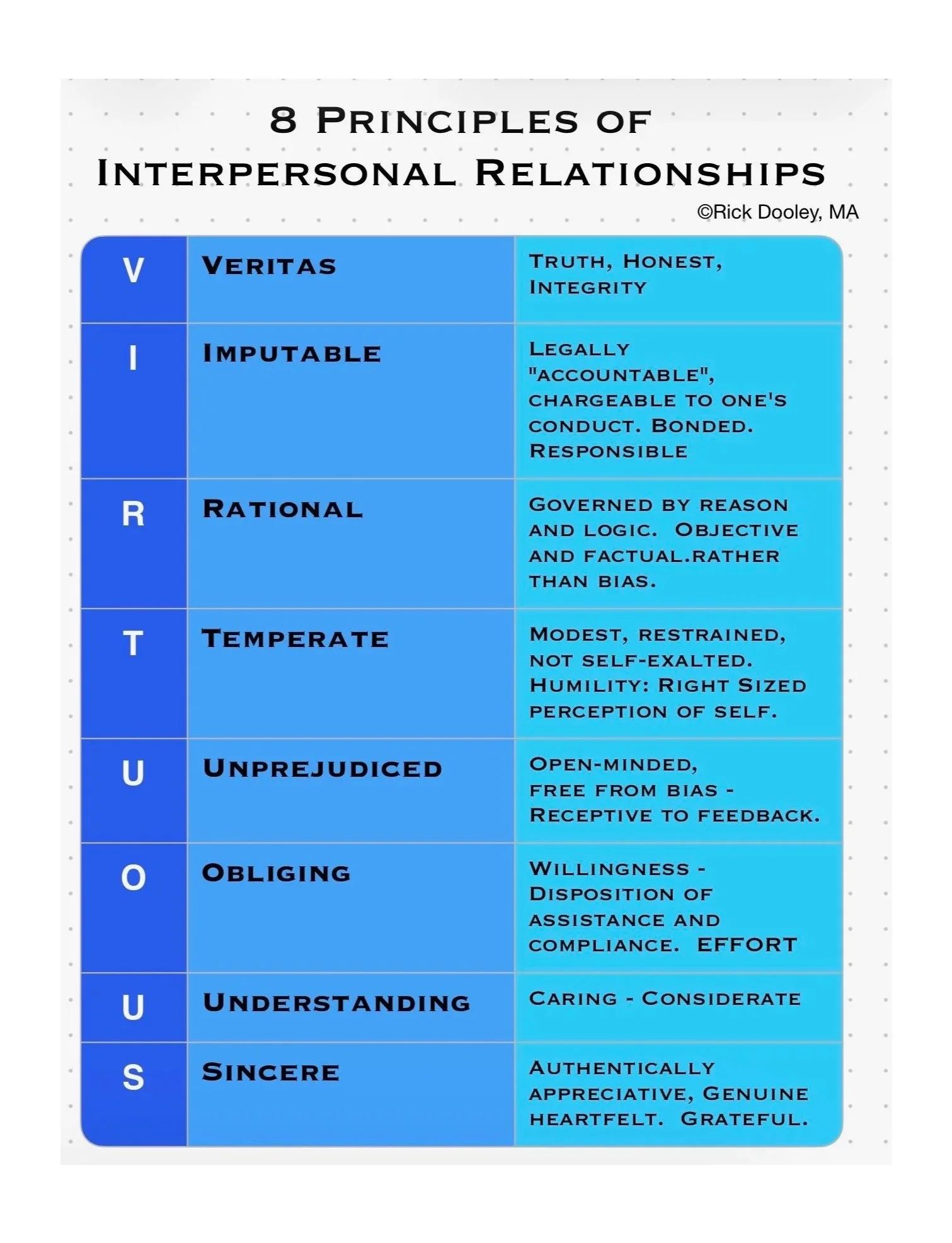
Healthy relationships don't happen by accident. They are built through intentional character development. In this series, we've been working through eight principles that form the acronym VIRTUOUS, each representing a quality that strengthens our relationships and reflects Christ's character.
So far we've covered:
Veritas – Truthfulness, honesty, and integrity.
Imputable – Taking responsibility and being accountable.
Rational – Being governed by facts and reason rather than emotional reactions.
Temperate – Practicing humility and self-restraint.
The fifth principle is Unprejudiced.
At first glance, this word can sound political or cultural, but that's not how we're using it. In the context of healthy relationships, being unprejudiced means being free from unnecessary bias, assumptions, and closed-mindedness. It means approaching people with a willingness to listen and learn rather than assuming we've already figured everything out.
Open-Minded Without Being Ungrounded
Many Christians hear the phrase "be open-minded" and immediately feel cautious. We've all heard the saying, "Don't be so open-minded that your brains fall out." That's a fair concern.
Being unprejudiced does not mean abandoning biblical convictions or treating truth as relative. Scripture is our authority, and God's standards are not negotiable.
Instead, being unprejudiced means recognizing the difference between holding firmly to truth and holding too tightly to our own assumptions.
There are many areas where our opinions, experiences, and first impressions are not the same thing as truth.
Healthy relationships require enough humility to ask:
What if I'm missing something?
What if this person sees something I don't?
What if God wants to teach me through someone I wouldn't normally listen to?
A Learner's Mentality
One of the simplest ways to describe this principle is with two words:
Stay teachable.
People who grow never assume they've arrived.
They enter conversations believing they still have something to learn.
Sometimes that lesson comes from a trusted friend.
Sometimes it comes from someone completely different than ourselves.
Sometimes it even comes from someone we don't particularly like.
That doesn't mean every opinion deserves equal weight. It means we're willing to examine what we hear rather than dismissing it before we've listened.
Proverbs repeatedly praises the wise person who welcomes correction while warning against the fool who refuses instruction.
A learner's mentality says,
"I don't know everything yet."
That attitude transforms relationships.
Where Our Biases Come From
Most of our assumptions weren't consciously chosen.
They're often formed through:
Family upbringing
Cultural experiences
Painful relationships
Previous betrayals
Successes and failures
Personal fears
Sometimes those experiences genuinely help us exercise wisdom.
Discernment matters.
Past experiences can protect us from repeating dangerous mistakes.
But they can also cause us to reject people before they've even had the opportunity to speak.
Healthy discernment asks,
"What is actually true?"
Bias often asks,
"What have I already decided?"
Those are very different questions.
Listening Is the First Step
If you're wondering how to become more open-minded without compromising your convictions, the first practical step is surprisingly simple:
Listen.
Listening doesn't mean agreement.
Listening doesn't mean surrendering your beliefs.
Listening simply means giving someone enough respect to understand what they're actually mean before deciding whether they're right or wrong.
Many of us are far more interested in preparing our response than understanding the other person's heart.
Real listening requires us to pause our internal arguments long enough to understand another perspective.
That's not weakness.
It's maturity.
Sometimes the People We Least Want to Hear Tell Us the Truth
This may be one of the hardest parts of healthy relationships.
Sometimes criticism comes from people who genuinely love us.
Sometimes it comes from people who don't.
Either way, the question remains:
Is there any truth in what they're saying?
It's easy to dismiss criticism because of the source.
It's much harder—but far more beneficial—to evaluate the content.
One helpful principle from recovery ministry says:
"Take what you can and leave the rest behind."
Not every criticism is accurate.
But not every criticism is false either.
Wisdom filters rather than automatically rejecting.
The Greatest Bias May Be About Ourselves
Perhaps the hardest prejudice to overcome is the one we have toward our own story.
Each of us carries a narrative about who we are.
We believe we understand our motives.
We believe we know why we act the way we do.
Then someone points out something that doesn't fit our narrative.
Immediately, we become defensive.
But what if they're seeing something we've missed?
Growth begins when we're willing to let trusted people speak into our lives.
This is why humility and open-mindedness are inseparable.
The stronger our identity is in Christ, the less threatened we become by correction.
Marriage Reveals This Principle Quickly
Few relationships expose our level of openness like marriage.
Many couples eventually reach a point where they stop hearing one another.
The issue usually isn't communication.
It's trust.
When trust erodes through sarcasm, criticism, defensiveness, inconsistency, or emotional distance, feedback no longer feels safe.
Instead of hearing concern, we hear accusation.
Instead of hearing help, we hear attack.
Healthy marriages require both spouses to cultivate an attitude that says,
"Help me understand what you're seeing."
That doesn't mean every complaint is accurate.
It means we're willing to consider it before rejecting it.
Active Listening Builds Trust
One practical skill that reflects an unprejudiced heart is active listening.
Rather than preparing your rebuttal while someone speaks, active listening seeks first to understand.
It sounds like this:
"What I'm hearing you say is..."
"Did I understand you correctly?"
"Help me understand what that felt like."
Even if you disagree with the conclusion, you've communicated something incredibly valuable:
"You matter enough for me to understand you."
That kind of respect opens doors that arguments rarely do.
Jesus Modeled This Perfectly
Jesus never compromised truth.
He never softened God's standards.
Yet He consistently listened to people.
He asked questions.
He engaged outsiders.
He welcomed sinners.
He interacted with people others avoided.
His confidence in truth allowed Him to listen without fear.
Christians should possess the same confidence.
Because our identity is rooted in Christ, we don't have to fear every different opinion.
We can listen carefully, evaluate biblically, and respond graciously.
Questions for Reflection
Take a few moments to honestly consider these questions:
Who am I least willing to listen to?
Do I become defensive when someone offers correction?
Am I more interested in being right than in learning?
Is there someone in my life whose feedback I've dismissed too quickly?
What assumptions do I regularly make about other people?
Am I known as someone who welcomes truth, even when it's uncomfortable?
Final Thoughts
Being unprejudiced isn't about abandoning discernment.
It's about refusing to let assumptions replace truth.
It's choosing humility over certainty.
Learning over pride.
Listening over defensiveness.
Healthy relationships are built by people who remain teachable.
When we're grounded in God's truth, we don't have to fear hearing another perspective. Instead, we can listen carefully, examine wisely, hold fast to what is true, and continue growing into the image of Christ.
That kind of openness doesn't weaken relationships.
It strengthens them.