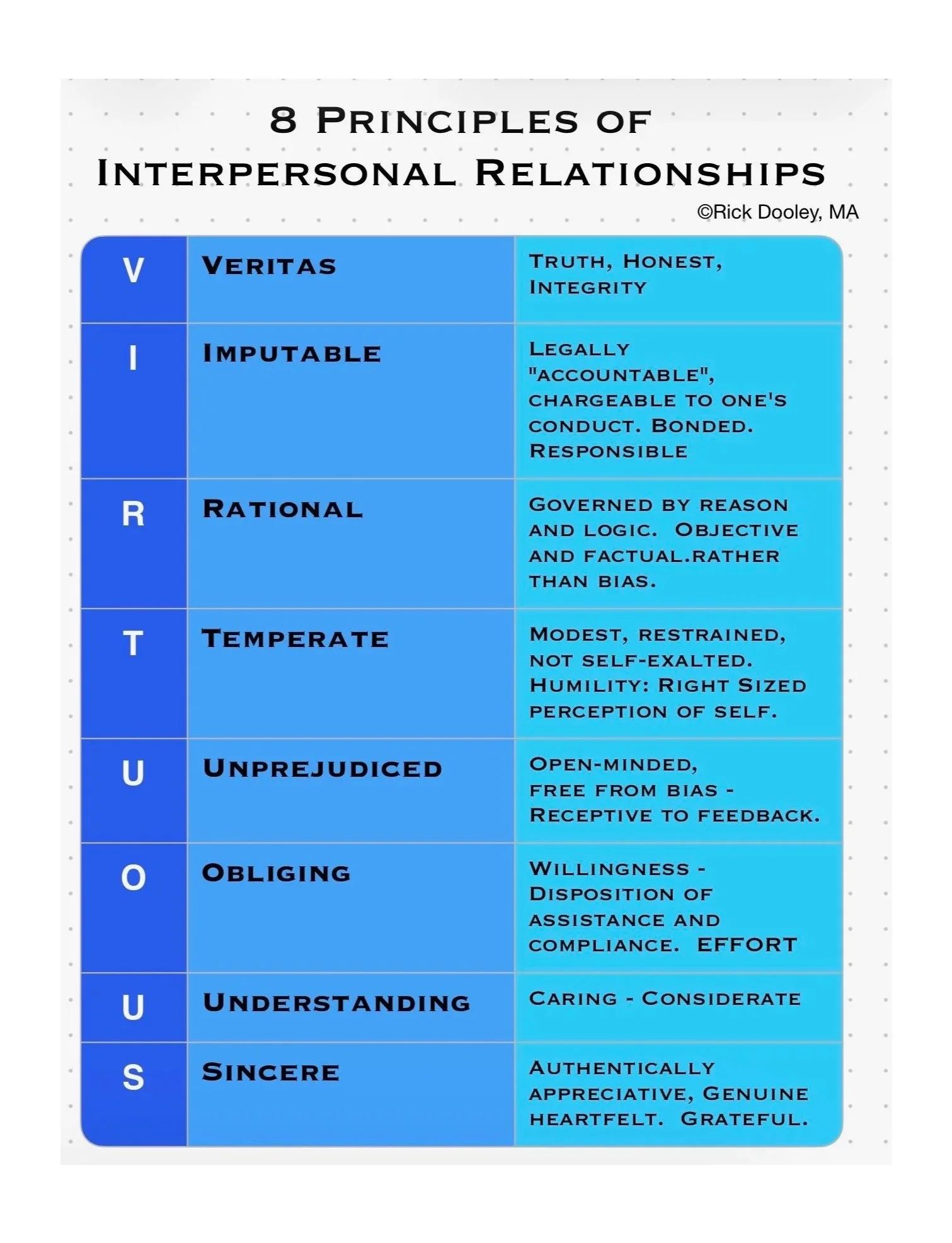
8 Principles of Healthy Relationships: #6 Obliging
Healthy Relationships Require More Than Agreement—They Require an Obliging Spirit
"Do nothing from selfish ambition or conceit, but in humility count others more significant than yourselves." — Philippians 2:3
Healthy relationships are not built merely by avoiding conflict. They are built by learning how to move toward one another with kindness, flexibility, and a genuine desire to serve.
In our last article, we discussed the importance of being unprejudiced—approaching others with an open mind rather than allowing assumptions and bias to shape our relationships. That naturally leads us to the sixth principle of healthy relationships:
O — Obliging
The word obliging isn't one we hear often anymore, but its meaning is deeply biblical.
An obliging person is:
Helpful rather than resistant.
Cooperative rather than combative.
Willing to serve rather than insisting on being served.
Flexible rather than rigid.
Looking for ways to make relationships flourish instead of simply proving themselves right.
Being obliging does not mean becoming a doormat. It does not mean abandoning biblical convictions or healthy boundaries. Rather, it means developing a heart that asks,
"How can I bless this person?"
instead of,
"How can I get my way?"
Our Default Setting
Most of us naturally approach relationships asking questions like:
What do I want?
What do I need?
How is this affecting me?
The Bible consistently points us in another direction.
Philippians 2 calls believers to imitate Christ by considering others more important than ourselves.
That doesn't mean we pretend our needs don't matter.
It means we intentionally look beyond ourselves.
An obliging spirit is one that willingly adjusts, serves, and sacrifices for the good of another whenever doing so honors God.
The Difference Between Being Nice and Being Obliging
Many people confuse these ideas.
Being nice often means avoiding conflict.
Being obliging means actively seeking another person's good.
Jesus was perfectly obliging.
He washed feet.
He served the undeserving.
He listened.
He sacrificed.
But He also confronted sin.
He spoke hard truths.
He refused manipulation.
Obliging isn't passive.
It's purposeful love.
Relationships Die When Everyone Keeps Score
One of the greatest enemies of marriage, friendship, and even church life is keeping score.
"I cooked dinner yesterday."
"I always apologize first."
"They never appreciate me."
"I did this last week."
When every act of service becomes a transaction, relationships slowly become negotiations.
Eventually each person begins waiting for the other to move first.
Nothing changes.
An obliging person breaks that cycle.
Instead of asking,
"Why should I?"
they ask,
"What would love do?"
Active Listening Is an Act of Service
One of the biggest applications we discussed on the podcast was active listening.
Most people don't actually listen.
They're simply waiting for their turn to speak.
While another person is talking, we're already:
preparing our defense,
explaining ourselves,
planning our comeback,
or deciding why they're wrong.
That's not listening.
Active listening means giving someone your attention long enough to truly understand what they're mean.
A helpful question is:
"Let me see if I understand what you're mean..."
Then summarize what you heard.
Even if you misunderstand, people often feel respected simply because you cared enough to try.
And feeling understood opens doors that arguments rarely can.
You Don't Have to Agree to Be Respectful
This is one of the most freeing truths in healthy relationships.
Listening does not require agreement.
Understanding does not require endorsement.
Respect does not require surrendering your convictions.
Jesus constantly listened to people whose conclusions He rejected.
He engaged them.
He asked questions.
He understood their hearts.
Then He lovingly spoke truth.
Sometimes Christians become afraid that listening means compromising.
It doesn't.
Listening simply communicates:
"You matter enough for me to understand you."
That alone often changes the tone of a relationship.
Marriage Often Reveals the Need for an Obliging Spirit
Few places expose selfishness more quickly than marriage.
Over time couples can develop patterns where neither person feels heard.
Trust erodes.
Every conversation feels like criticism.
Every disagreement becomes another reminder that "they never understand me."
The result?
Both spouses stop listening.
But healthy marriages rarely begin changing because one spouse wins an argument.
They begin changing when someone chooses humility.
When someone says,
"Help me understand."
When someone serves first.
When someone listens first.
When someone seeks the other's good before demanding their own.
That posture doesn't guarantee immediate change.
But it creates space where trust can begin growing again.
The Example of Christ
Ultimately, every one of these principles points us back to Jesus.
No one has ever been more obliging than Christ.
Philippians 2 tells us that although He existed in the very nature of God,
He humbled Himself.
He took the form of a servant.
He became obedient unto death—even death on a cross.
Jesus never stopped being truthful.
He never compromised holiness.
He never abandoned righteousness.
Yet He continually laid aside His own comfort to pursue the good of others.
That's the model for every healthy relationship.
Questions for Reflection
As you consider this principle, ask yourself:
Do I enter conversations trying to understand or trying to win?
Am I known as cooperative or difficult?
Do people feel heard after talking with me?
When was the last time I intentionally served someone without expecting anything in return?
Am I willing to inconvenience myself for another person's good?
Healthy relationships aren't built by demanding better treatment.
They're built by becoming the kind of person who reflects Christ.
An obliging spirit doesn't weaken your convictions.
It strengthens your relationships.
The Eight Principles of Healthy Relationships
Veritas — Live with truth, honesty, and integrity.
Imputable — Take responsibility for your actions.
Rational — Be governed by truth rather than emotion.
Temperate — Practice humility and self-restraint.
Unprejudiced — Be open to learning and receiving feedback.
Obliging — Seek to serve, listen, and cooperate with others.
Understanding — (Coming next.)
Sincere — (Coming soon.)
Healthy relationships are not accidental—they are cultivated. As you grow in these virtues, you'll not only strengthen your relationships with others, but you'll increasingly reflect the character of Christ in every interaction.