8 Principles Q & A
Healthy Relationships Aren't Found—They're Built
How eight biblical principles can transform every relationship in your life.
One of the most common questions people ask is, "How do I improve my relationships?" We often assume the answer is finding better people, avoiding difficult personalities, or escaping conflict.
But what if healthier relationships begin with becoming a healthier person?
In a recent episode of Form: A Counseling Podcast, Rick Dooley and I stepped back from discussing individual principles and instead summarized what we've learned through our series on healthy relationships. We also answered listener questions about how these principles work in real life.
The conclusion was simple:
Healthy relationships are not built on finding perfect people. They're built by practicing biblical virtues regardless of how others respond.
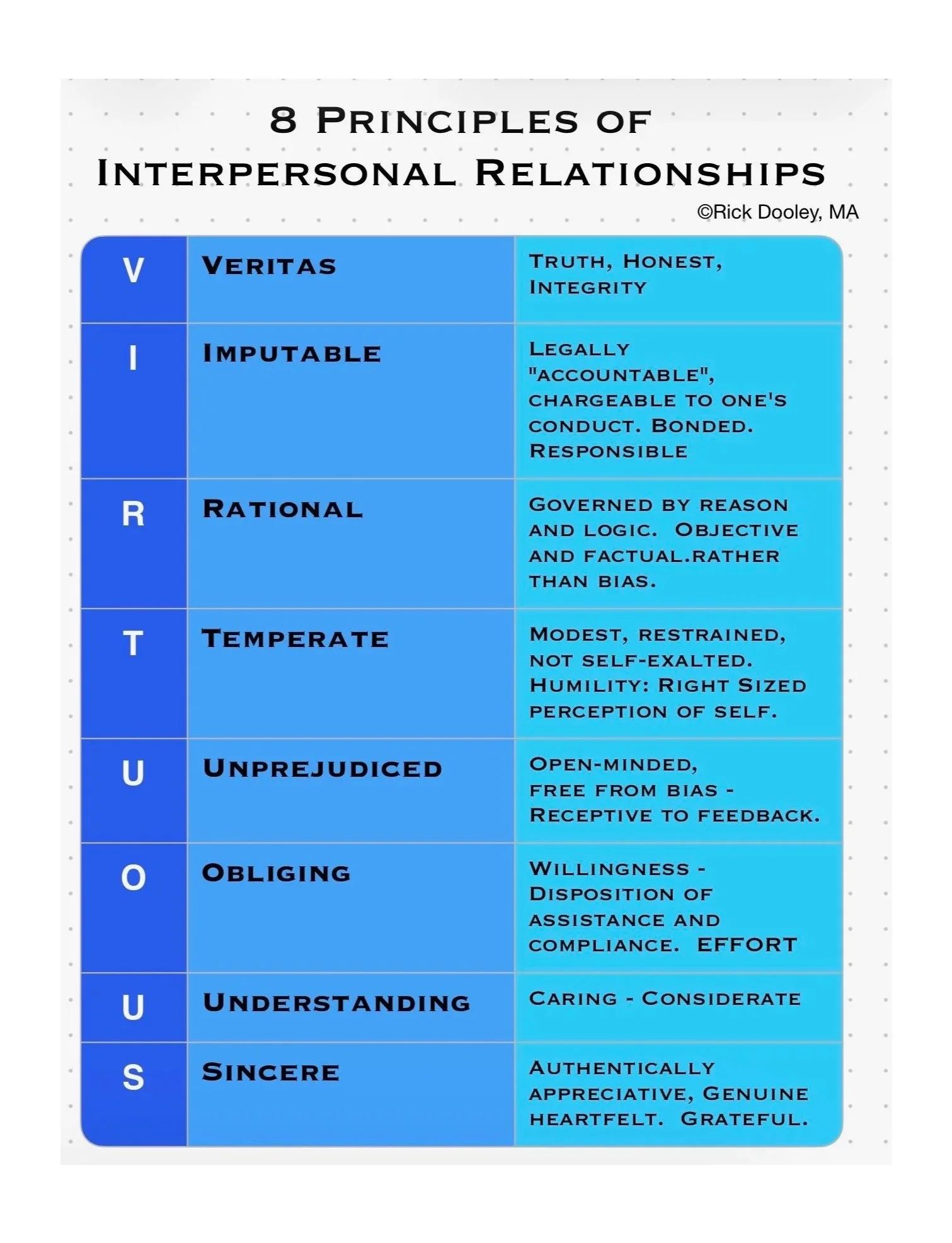
The Eight Principles of Healthy Relationships
Throughout this series we've discussed eight interconnected principles. They are not eight separate techniques to pick and choose from. Together they describe the character of someone who cultivates healthy relationships.
1. Veritas — Truth
Every healthy relationship begins with truth.
Truthfulness isn't merely avoiding lies. It is becoming someone whose words can be trusted because they consistently reflect integrity.
Speaking the truth is not always comfortable. Sometimes honesty carries consequences. Yet trust cannot exist where truth is absent.
As Scripture reminds us, we are called to speak the truth in love. Both truth and love matter.
2. Imputable — Personal Responsibility
Healthy people own their actions.
Rather than blaming circumstances, other people, or past experiences, they willingly accept responsibility for both successes and failures.
Confession is more than explaining yourself.
Many people apologize while secretly defending themselves. Genuine confession simply agrees with reality. It says:
"I was wrong."
Without excuses.
Without manipulation.
Without shifting blame.
Responsibility builds trust because it demonstrates humility.
3. Rational — Seeing Reality Clearly
Many conflicts are not caused by evil intentions.
They're caused by misunderstanding.
One of the greatest relationship skills is learning to slow down enough to ask,
"Did I actually hear what you meant?"
Active listening forces us to temporarily step outside our own perspective and accurately represent another person's thoughts before responding.
Objectivity doesn't require abandoning convictions.
It requires accurately understanding reality before evaluating it.
4. Temperate — Being Right-Sized
Humility isn't thinking less of yourself.
Neither is it thinking more of yourself.
It's seeing yourself accurately.
Some people dominate every conversation.
Others disappear from every conversation.
Neither reflects biblical humility.
Being "right-sized" means recognizing both your value and your limitations. It means remembering who you are in relationship to Christ.
5. Open-Minded — Willing to Receive Feedback
Every one of us carries assumptions shaped by family, culture, experiences, and past wounds.
Healthy people acknowledge those influences without allowing them to become permanent blind spots.
Being open-minded doesn't mean abandoning convictions.
It means remaining teachable.
Ironically, people who listen well are usually the ones others are most willing to listen to.
6. Obliging — Choosing to Invest
Relationships require effort.
Love is not passive.
Healthy people don't simply wait for others to initiate kindness, forgiveness, encouragement, or service.
They willingly take the first step.
Commitment isn't measured by feelings.
It's measured by faithfulness.
7. Understanding — Extending Grace
Everyone wants to be understood.
Few people intentionally work to understand others.
Understanding means slowing down long enough to consider another person's history, emotions, fears, and perspective before reacting.
It doesn't excuse sin.
It simply refuses to assume the worst.
Grace creates space where growth becomes possible.
8. Sincere — Practicing Genuine Gratitude
Healthy relationships are marked by authentic appreciation.
Not manipulation.
Not flattery.
Real gratitude.
People instinctively recognize the difference between empty compliments and sincere appreciation.
When gratitude becomes part of your character, relationships deepen because people know your words are genuine.
What If the Other Person Won't Change?
One listener asked:
"What if my spouse isn't interested in any of this?"
It's an important question.
The temptation is to conclude these principles only work when both people participate.
But Scripture consistently calls us to obedience regardless of another person's response.
You cannot control someone else's heart.
You can control how you show up.
Ironically, when one person genuinely changes, the entire relationship changes.
Not always because the other person immediately improves.
Sometimes because your responses no longer reinforce unhealthy patterns.
Sometimes because healthy behavior invites healthier responses.
Sometimes because unhealthy people choose to distance themselves from health.
Regardless, your responsibility remains the same.
You Can't Invest Deeply in Every Relationship
Another listener asked:
"Should I pursue every relationship?"
No.
Jesus commands us to love everyone.
He does not command us to cultivate deep friendships with everyone.
Healthy friendships pull us toward Christ.
Unhealthy friendships consistently pull us away from Him.
One helpful question is:
Does this person consistently want the best for the best part of me?
That question alone can transform how we evaluate relationships.
One Healthy Person Changes Every Relationship
Rick shared a simple example from counseling.
Imagine someone constantly has terrible experiences at doctor's appointments.
They assume every physician is rude.
Every nurse is dismissive.
Every visit becomes frustrating.
But what if they simply changed how they entered the room?
What if they sincerely thanked the staff?
What if they acknowledged how busy everyone was?
What if they approached the appointment with humility instead of entitlement?
Nothing else changes.
Yet the entire interaction often changes.
The circumstances remain the same.
The person changes.
And relationships respond.
Do You Actually Believe People Can Change?
Perhaps the biggest question isn't whether these principles work.
The bigger question is whether you still believe change is possible.
Many of us have become cynical.
We've been hurt enough times to believe nothing will ever improve.
But the gospel tells a different story.
God changes people.
Not instantly.
Not effortlessly.
But genuinely.
If Christ can transform sinners into saints, He can certainly continue transforming us into healthier husbands, wives, parents, friends, coworkers, and church members.
One Practical Challenge
Don't try to master all eight principles this week.
Instead:
Identify the one principle you struggle with most.
Set one small, practical goal.
Practice it intentionally this week.
Evaluate what changed.
Small steps often produce surprisingly significant results.
Healthy relationships rarely emerge overnight.
They are built through countless ordinary decisions to become a little more truthful, a little more humble, a little more understanding, and a little more like Christ.
Because ultimately, these eight principles aren't merely communication skills.
They're a picture of the character of Jesus Himself.
And the more we become like Him, the healthier every relationship has the opportunity to become.