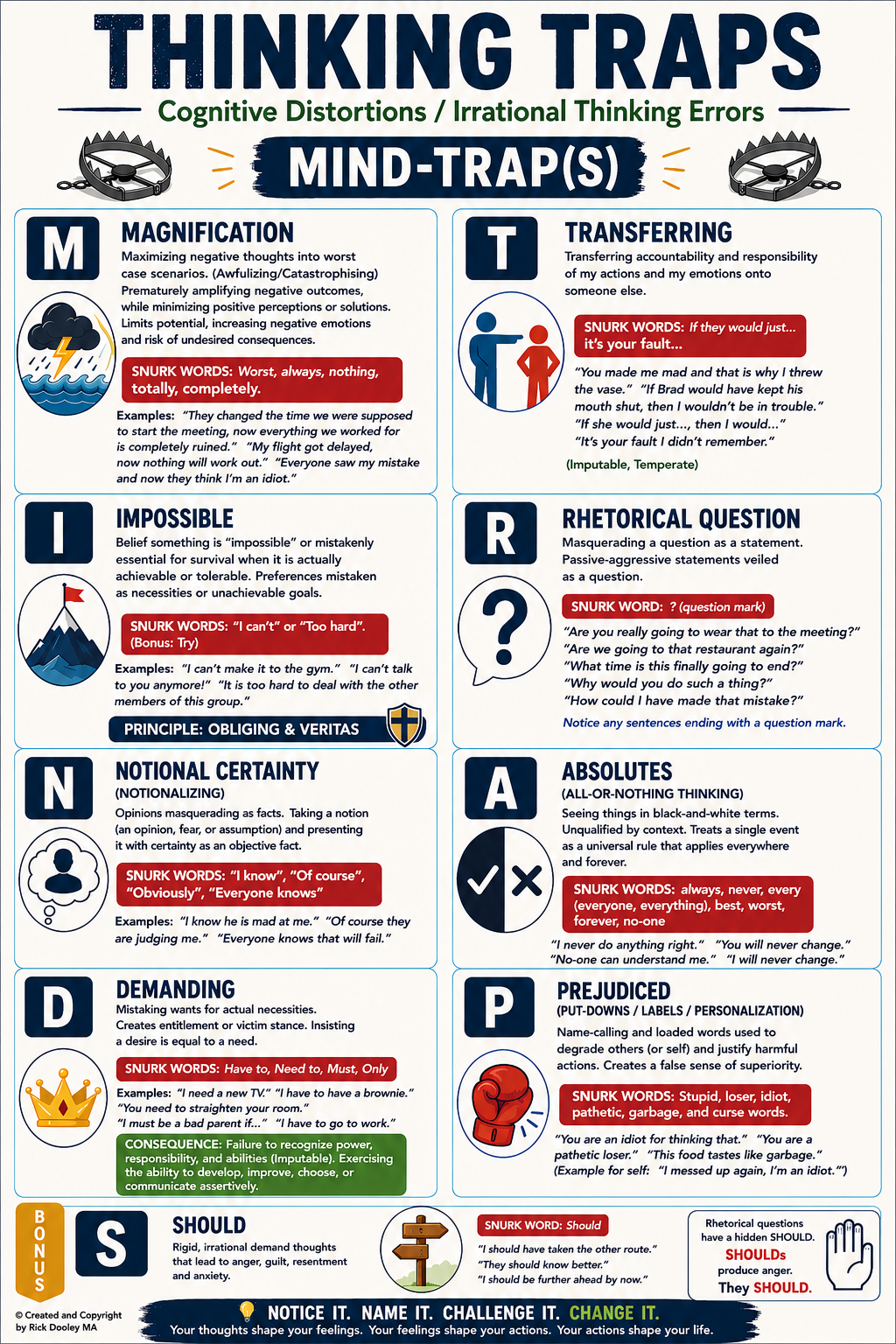
MIND TRAP(S) #1: Two Thinking Errors That Quietly Control Your Life
MIND TRAPS (Part 1): Two Thinking Errors That Quietly Control Your Life
"Take every thought captive to obey Christ." — 2 Corinthians 10:5
What if many of your strongest emotions weren't caused by your circumstances, but by the way you interpreted them?
That's the premise behind the first episode in our new MIND TRAPS series with counselor Rick Dooley, M.A. In this series, we're exploring what psychology often calls cognitive distortions or irrational thinking errors—patterns of thinking that distort reality, intensify emotions, and damage relationships.
But we aren't simply interested in psychology.
We're interested in how these thinking patterns intersect with the biblical command to take every thought captive (2 Corinthians 10:5). Scripture teaches that sin affects every part of us—including our thinking. Many of our destructive habits begin long before our actions; they begin with the stories we tell ourselves.
The encouraging news is that distorted thinking can be challenged and replaced with truth.
Why This Matters
Most people don't spend much time thinking about their thinking.
Life happens. We immediately interpret it. Those interpretations create emotions, and those emotions often drive our words and actions.
When left unexamined, irrational thoughts quietly become the foundation for unhealthy relationships, unnecessary anxiety, anger, discouragement, and even hopelessness.
Rick often reminds clients that these thinking errors exist on a spectrum. Everyone experiences them. The goal isn't perfection—it is awareness. Once you recognize the pattern, you can begin replacing it with truth.
The Rational Self-Analysis (RSA)
Throughout this series we refer back to a practical counseling tool called the Rational Self-Analysis (RSA).
It follows a simple progression:
A – Activating Event: Something happens.
B – Beliefs: You automatically interpret what happened.
C – Consequences: Those beliefs produce emotions and behaviors.
The key insight is this:
It isn't usually the event itself that creates our emotional response—it is what we believe about the event.
The goal of the RSA is to identify irrational beliefs and replace them with truthful, rational, and ultimately biblical thinking.
MIND TRAP #1: Magnification
Magnification is also known as catastrophizing or awfulizing.
This thinking error takes a real problem and mentally enlarges it until it feels like the worst possible scenario.
Common examples include:
"Everything is ruined."
"Nothing is going to work out."
"This is the worst day ever."
"I'll never recover from this."
These thoughts often appear after situations like:
A delayed flight
A schedule change
An embarrassing mistake
A disagreement with someone
Receiving criticism
The event may genuinely be disappointing.
The distortion happens when our minds convince us that one setback defines everything else.
Snurk Words
Rick calls these verbal warning signs Snurk Words—words that signal irrational thinking may be taking over.
For Magnification, listen for:
Worst
Always
Nothing
Totally
Completely
These words exaggerate reality and shrink our ability to see solutions.
The Hidden Cost
Magnification narrows our vision.
Instead of asking,
"How can I respond well?"
we begin believing,
"There is no point anymore."
Many people quit—not because failure was inevitable—but because their thinking convinced them it already was.
Ironically, some of the people we admire most endured repeated failure before succeeding.
The problem wasn't their circumstances.
The difference was their interpretation.
Vulnerability Isn't Usually the Disaster We Imagine
One of the most helpful observations in the episode was this:
Many people fear that if they admit weakness or failure, they will permanently lose the respect of others.
In reality, the opposite is often true.
Authentic vulnerability frequently earns more respect than carefully maintaining an image of perfection.
Our minds predict rejection.
Reality often brings connection.
That's another reason distorted thinking must continually be challenged.
MIND TRAP #2: Impossible
The second thinking trap is the belief that something is impossible—or unbearable—when it is actually difficult but completely survivable.
Its favorite phrases are:
"I can't."
"It's too hard."
Sometimes those statements are literally true.
Often they aren't.
Frequently, "I can't" actually means "I don't want to."
That distinction matters.
There is a tremendous difference between lacking ability and lacking willingness.
Replacing "I can't" with truthful language restores ownership of our choices.
Instead of saying:
"I can't go."
we may discover the more truthful statement is:
"I don't want to go."
That honesty may feel uncomfortable, but it creates opportunities for genuine conversations instead of excuses.
The Bonus Thinking Error: "I'll Try"
Rick also challenges another common phrase:
"I'll try."
Many times "I'll try" isn't a commitment.
It's a socially acceptable way of avoiding accountability.
Instead of honestly saying,
"I don't intend to do that,"
we soften our language to avoid conflict.
Truthfulness—even when difficult—is healthier than vague promises we never intend to keep.
Replacing Distortion with Truth
Christian growth is never simply about removing bad habits.
It is about replacing them.
When Scripture calls us to repent, it calls us not only to turn away from falsehood but to turn toward truth.
That means replacing irrational beliefs with biblical ones.
Instead of:
"Everything is ruined."
learn to say,
"This is disappointing, but it isn't the end."
Instead of:
"I can't."
consider,
"This is difficult, but I can endure it."
Instead of:
"Nothing will work out."
remember,
"God has faithfully carried me through difficult situations before."
Truth doesn't minimize hardship.
It simply refuses to exaggerate it.
A Practical Challenge
This week, simply become aware of your language.
Pay attention whenever you hear yourself saying:
Worst
Always
Nothing
Totally
Completely
I can't
It's too hard
I'll try
Rather than condemning yourself, pause and ask:
Is this statement actually true?
Am I exaggerating?
Is this describing reality—or only how I currently feel?
What would be a more truthful way to say this?
Awareness is the first step toward change.
As we continue this MIND TRAPS series, we'll explore additional thinking errors that quietly influence our relationships, emotions, and spiritual growth. Learning to identify them is one more way we can obey Paul's command to take every thought captive to the obedience of Christ.