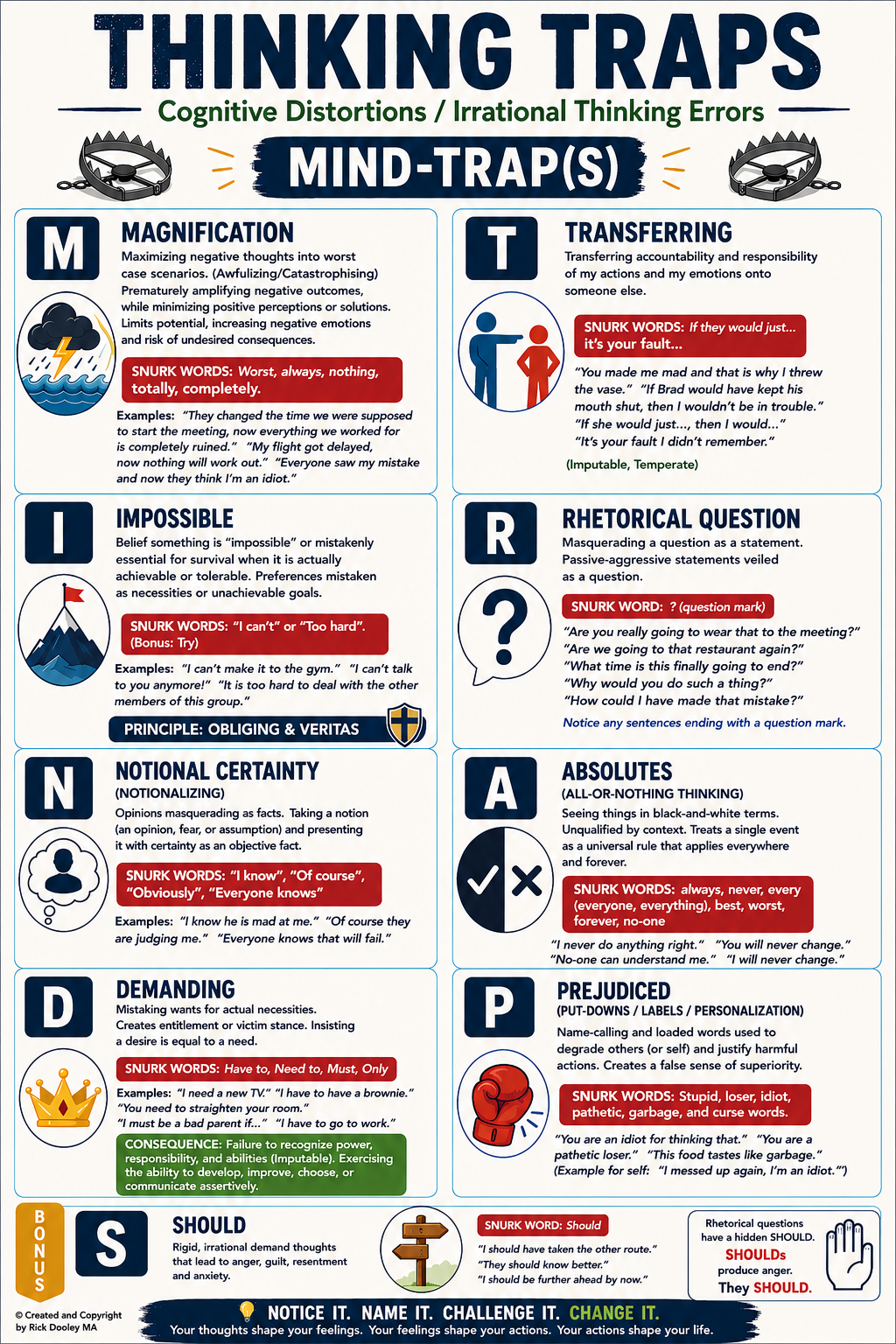
MIND-TRAP(S) #2: How Irrational Thinking Sabotages Healthy Relationships (Part 2)
Every relationship is shaped by the stories we tell ourselves.
Sometimes those stories are true. Other times they're assumptions, exaggerations, or outright distortions of reality. The danger is that if we repeat these thoughts long enough, we begin to believe them—and once we believe them, they begin to shape how we speak, react, and relate to others.
In a recent episode of Form: A Counseling Podcast, Rick Dooley and Devin Leitch continued their discussion on what they call MIND-TRAP(S)—common patterns of irrational thinking that quietly sabotage healthy relationships.
The encouraging news is that these thinking errors are common, recognizable, and correctable.
Healthy Relationships Require Healthy Thinking
In previous episodes we introduced the Eight Principles of Healthy Relationships. Those principles describe what we should be moving toward.
Mind traps describe what pulls us away from those principles.
Think of it this way:
Healthy relationship principles are the destination.
Mind traps are the potholes that keep us from getting there.
Most of us don't intentionally damage our relationships. We simply allow unhealthy thought patterns to go unchallenged until they become our default way of interpreting life.
The First Step Is Awareness
One of the biggest misconceptions about irrational thinking is that noticing it means you've failed.
Actually, the opposite is true.
The moment you recognize a thinking error is the moment you've interrupted it.
Awareness is the beginning of change.
Rick often says he'd like to hear applause every time someone catches one of these thinking errors because recognizing it means you're breaking an old pattern instead of remaining on autopilot.
Don't become discouraged because you discover these patterns in your own thinking. Every person has them. Growth begins when we stop ignoring them.
Mind Trap #1: Magnification
Magnification is the tendency to make a problem much larger than it really is.
Psychologists sometimes call it catastrophizing or awfulizing.
A delayed flight suddenly becomes:
"Nothing is going to work out."
A scheduling mistake becomes:
"Everything is ruined."
One awkward conversation becomes:
"Everyone thinks I'm an idiot."
Notice the absolute language.
Those are what Rick calls "snark words."
Common snark words for magnification include:
Always
Never
Completely
Totally
Nothing
Ruined
Worst
These words inflate ordinary disappointments into disasters.
Certainly there are genuine tragedies in life. But many of the things we emotionally label as catastrophic are simply inconveniences.
When we magnify problems, we prepare ourselves for battle against an enemy that often doesn't exist.
The Biblical Alternative
Instead of asking,
"How terrible is this?"
Ask,
"What is actually true?"
Temperance reminds us to be rightly sized.
Sincerity reminds us to be honest.
Veritas reminds us to tell ourselves the truth.
Most mistakes are simply mistakes—not life-defining catastrophes.
Mind Trap #2: "I Can't"
The second trap is what Rick calls Impossible Thinking.
Its signature phrase is simple:
"I can't."
Of course, sometimes "I can't" is literally true.
You can't jump to the moon.
You can't breathe underwater.
But many times "I can't" really means something different.
It means:
"This is difficult."
"I don't want to."
"I'm uncomfortable."
"I'm afraid."
That's a very different statement.
Changing our language changes our thinking.
Instead of saying,
"I can't have that difficult conversation."
We may need to admit,
"I'm afraid to have that conversation."
That honesty gives us something we can actually address.
Politeness Can Hide Dishonesty
This becomes especially challenging in Southern culture.
Suppose someone invites you to a party.
Many people instinctively respond,
"I can't make it."
But perhaps the truth is:
"I'm choosing not to come."
That sounds harsh, and we shouldn't become rude.
The goal isn't brutal honesty.
The goal is truthful thinking.
There is usually a gracious way to communicate honestly without deceiving yourself or misleading someone else.
Learning to distinguish between "I can't" and "I won't" helps us take ownership of our choices.
Mind Trap #3: Notional Certainty
Another dangerous pattern is assuming we know what someone else is thinking.
Your boss doesn't smile.
Immediately your mind concludes:
"They're upset with me."
A friend doesn't respond to your text.
You decide:
"They're angry."
Someone volunteers for a ministry.
You assume:
"They're just on a power trip."
None of those conclusions are facts.
They're notions.
The problem isn't having a first impression.
The problem is becoming certain about something you don't actually know.
Humility asks better questions.
Instead of assuming motives, curiosity asks,
"Can you help me understand what happened?"
Curiosity builds relationships.
Certainty without evidence destroys them.
Be Skeptical of Your Own Conclusions
One observation we discussed came from Alistair Begg.
Because we are sinners, we ought to maintain a healthy skepticism toward our own conclusions.
That doesn't mean doubting everything.
It means remembering that our perspective is limited.
We are capable of misunderstanding situations, misreading motives, and filling in gaps with assumptions.
Wisdom pauses before declaring certainty.
Curiosity Changes Relationships
One of the most practical applications of this principle is parenting.
Instead of immediately assuming you know why your child made a poor decision, ask:
"Can you help me understand what was going through your mind?"
That question communicates something powerful.
"I'm for you."
It invites conversation instead of defensiveness.
The same principle transforms marriages, friendships, churches, and workplaces.
A Challenge This Week
Pay attention to your own vocabulary.
Listen for your "snark words."
Notice when you say:
Always
Never
Completely
I can't
I have to
They must
Everybody knows
When you hear them, don't shame yourself.
Pause.
Ask yourself:
Is that actually true?
Am I assuming something?
Am I exaggerating?
What evidence do I really have?
What would a truthful, biblical perspective sound like?
Healthy relationships begin long before words leave our mouths.
They begin in the thoughts we choose to believe.
As the apostle Paul reminds us, believers are called to "take every thought captive to obey Christ" (2 Corinthians 10:5).
When we learn to recognize mind traps, we become better communicators, wiser friends, healthier spouses, more gracious parents, and more faithful followers of Christ.