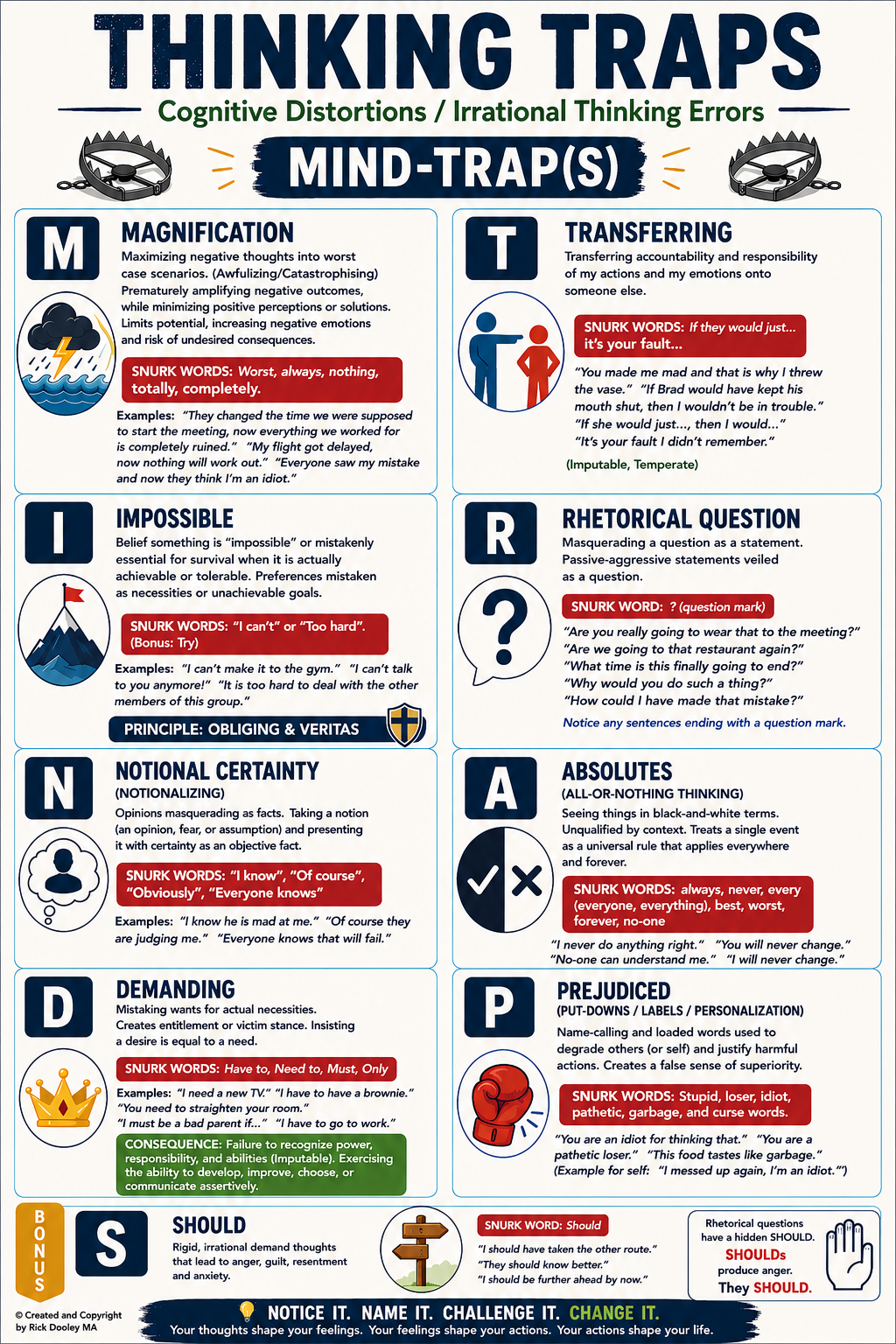
MIND-TRAP(S) #5 “Should”
The Mind Trap of “Should”: When Expectations Keep Us Stuck
One of the most common words in our thinking is also one of the most deceptively powerful:
Should.
They should have known better.
She should have treated me differently.
He should have done his job.
I should have taken that exit.
My spouse should know what I want.
Things shouldn't have turned out this way.
Sometimes these statements are completely reasonable. Sometimes they reflect genuine moral obligations or appropriate expectations. But other times, the word should becomes a mental trap—a rigid demand that reality be different from what it actually is.
In this episode of Form: A Counseling Podcast, Rick Dooley and Devin Leitch explore the irrational “should” and why it can keep us angry, frustrated, resentful, and stuck.
What Are MIND TRAP(S)?
The “S” in MIND TRAP(S)—Should—is especially important because the idea of “should” can run through nearly every other irrational thinking error.
The framework includes:
M — Magnification: Making a problem bigger than it actually is through awfulizing or catastrophizing.
I — Impossible: Saying “I can't” when you actually possess the ability to do something, even if it is difficult.
N — Notional Certainty: Treating an opinion or assumption as though it were an established fact.
D — Demanding: Turning wants into perceived needs through words such as have to, must, or need to.
T — Transferring: Giving responsibility for your emotions or behavior to someone or something else.
R — Rhetorical Questions: Using questions that are really disguised statements or criticisms.
A — Absolutes: Using words such as always, never, or everything when they are not literally true.
P — Prejudice: Using harsh labels or loaded words rather than clearly describing the problem.
S — Should: Demanding that reality, other people, or even ourselves be different from what reality actually dictates.
Each of these traps can keep us from thinking clearly and finding solutions. They can interfere with relationships and contribute to anger, resentment, anxiety, discouragement, and other unwanted consequences.
The goal isn't simply to identify these thinking errors. The goal is to pause, examine our thinking, challenge irrational conclusions, and move toward more rational and responsible responses.
Not Every “Should” Is Irrational
This distinction is critical.
The problem isn't the word should itself. There are genuine moral and biblical “shoulds.”
For example:
You should not steal.
You should not lie.
You should love your neighbor.
You should pursue holiness.
These aren't merely personal preferences. They are grounded in moral reality and biblical authority.
The irrational “should” is different.
An irrational should is a rigid demand about how I think life, other people, or circumstances ought to be, even though reality has already demonstrated otherwise.
The difference can be understood this way:
A rational “should” is grounded in reality or legitimate moral obligation. An irrational “should” demands that reality conform to my expectations.
That distinction can be easy to miss.
Reality Versus the Standard
One of the most difficult things about the irrational should is that our expectations may actually be reasonable.
Someone may genuinely have treated you poorly.
Your boss may genuinely have treated you unfairly.
Your spouse may genuinely have failed to meet an appropriate responsibility.
Someone may have betrayed you.
You may have made a genuine mistake.
The question isn't necessarily whether your expectation was wrong.
The question is:
What happened?
If you missed the exit, you missed the exit.
You can say, “I should have taken that exit,” but that statement doesn't change reality. You didn't take it.
Once we acknowledge reality, we can begin solving the problem:
What can I do now?
That's very different from remaining mentally stuck on what should have happened.
“They Should Have…”
This becomes especially powerful in relationships.
Consider these statements:
“They should have treated me better.”
“She should have known what I wanted.”
“He should have done his job.”
“My spouse should have remembered.”
Sometimes those expectations are legitimate. But the fact that another person should have done something doesn't mean that they actually did it.
And once they haven't done it, repeating the should doesn't solve anything.
In counseling, it can be useful to affirm the legitimate part of a person's observation while helping them move forward:
“You're right. They shouldn't have treated you that way. But they did. What are you going to do now?”
That shift is crucial.
It moves the person from judgment of reality to responsibility within reality.
The “Skipping Record” of the Should
An irrational should can function like a record that keeps skipping.
Something happened.
You think:
It shouldn't have happened.
You revisit it.
It shouldn't have happened.
You talk about it again.
They shouldn't have done that.
You replay it in your mind.
They should have known.
But nothing changes.
The mind keeps returning to the gap between what happened and what you expected to happen.
The problem is not necessarily that your expectation was unreasonable. The problem is that you are allowing the unmet expectation to prevent you from responding to what is actually in front of you.
Reality says:
This happened.
The irrational should says:
But it shouldn't have happened.
And the mind becomes stuck between the two.
Anger Is a Clue
One of the most useful practical observations from this discussion is that irrational shoulds are closely connected to anger.
If you find yourself angry, frustrated, irritated, or resentful, it can be helpful to ask:
“What should do I believe has been violated?”
Maybe:
Someone should have respected me.
Someone should have apologized.
My spouse should have known.
My children should have listened.
My boss should have recognized my work.
Life should have been easier.
I should not have made that mistake.
This should not have happened to me.
The “should” may not always be spoken out loud.
Sometimes it is simply implied.
A child says, “He hit me.”
The implied should is:
“He shouldn't have hit me.”
An employee says, “My boss didn't give me the promotion.”
The implied should is:
“My boss should have given me the promotion.”
A spouse says, “You didn't ask me how my day was.”
The implied should may be:
“You should know to ask me that.”
Finding the hidden should can help us understand what is actually driving our emotions.
What's Underneath the Should?
Once we identify the should, we can become curious about what is underneath it.
This is where counseling can become particularly useful.
Ask yourself:
What am I assuming when I say, “They should”?
What do I believe I am entitled to?
What does it mean about me if this person doesn't do what I think they should?
What does it mean about them?
What am I afraid will happen if they don't do what I want?
Is this really about control?
Am I looking for respect?
Recognition?
Security?
Approval?
Love?
Attention?
Fairness?
Understanding?
James 4:1–2 provides a remarkably helpful framework:
“What causes quarrels and what causes fights among you? Is it not this, that your passions are at war within you? You desire and do not have, so you murder. You covet and cannot obtain, so you fight and quarrel.”
The passage forces us to look beneath the conflict.
What do I want?
Often, what we are fighting about on the surface isn't actually what is driving us underneath.
A person may think they are angry about an iPhone, a promotion, a birthday, or a spouse's behavior. But underneath that circumstance may be a desire for significance, acceptance, security, recognition, or control.
The surface issue may be simple.
The heart issue often isn't.
From Anger to Curiosity
One of the most practical changes we can make is moving from anger to curiosity.
Imagine a baby crying.
Instead of immediately concluding, “This baby shouldn't be crying,” a parent normally begins investigating:
Is the baby hungry?
Does the baby need sleep?
Is the diaper dirty?
Is something hurting?
Curiosity moves us toward a solution.
Anger can keep us focused on the problem.
The same principle applies to our own thinking.
Instead of:
“This shouldn't be happening!”
we can ask:
“What is happening?”
Then:
“What do I want?”
Then:
“What can I actually do about it?”
That shift can move us from emotional reaction toward problem solving.
The Problem of Trying to Control Other People
A major source of frustration is the belief that we can control other people.
We can't.
We are responsible for our own obedience, our own choices, our own responses, and our own conduct.
Romans 12:18 says:
“If possible, so far as it depends on you, live peaceably with all.”
Notice the qualification:
“So far as it depends on you.”
That puts the focus where it belongs.
I am responsible for what depends on me.
I cannot make another person obey.
I cannot make another person understand.
I cannot make another person apologize.
I cannot make another person meet my expectations.
I can communicate clearly. I can set appropriate boundaries. I can pursue reconciliation. I can speak truth. I can act righteously.
But I cannot control another person's choices.
That distinction is incredibly important for emotional and relational maturity.
Assertiveness Instead of Mind Reading
The irrational should can also interfere with healthy communication.
Consider:
“She should know what I want.”
Maybe she should.
But does she?
People aren't mind readers.
Instead of assuming another person should know, healthy assertive communication allows us to clearly articulate what we want and need.
Rather than:
“You should know better.”
we might say:
“This is what I would like you to do.”
Rather than:
“You should have remembered my birthday.”
we might say:
“Celebrating my birthday is important to me. I'd like us to make that a priority.”
Assertiveness doesn't guarantee that we will get what we want.
But it does move us from passive expectation toward personal responsibility.
Change “Should” to “Could”
Perhaps the most practical exercise from this discussion is incredibly simple:
Replace “should” with “could.”
Instead of:
“I should have taken that exit.”
Try:
“I could have taken that exit.”
Now you have room to ask:
“What could I do differently next time?”
Instead of:
“My boss should know how hard I work.”
Try:
“I could talk with my boss about the work I've been doing.”
Instead of:
“My spouse should know what I want.”
Try:
“I could tell my spouse what I want.”
Instead of:
“My child shouldn't have taken his brother's toy.”
Try:
“What could he do differently next time?”
The change from should to could doesn't erase morality.
It doesn't mean everything is acceptable.
It doesn't mean we stop correcting sin.
It simply changes the question from:
“Why isn't reality the way I think it should be?”
to:
“What can I do now?”
That's a much more productive question.
“Could” Requires Personal Responsibility
There's an important warning here.
Simply changing the word should to could isn't enough if we immediately use it to blame someone else.
For example:
“I could have taken that exit if you would just stop talking.”
We've technically changed the word, but we've simply transferred responsibility to someone else.
The goal is not linguistic trickery.
The goal is personal responsibility.
So:
“I could have taken that exit. I was distracted. Next time I'll pay closer attention.”
Now we have movement.
We have a problem.
We have acknowledged reality.
And we have identified something we can do differently.
Parenting: Don't Just Tell Children What Not to Do
This principle has a powerful application for parents.
It is easy to tell children what they shouldn't do.
“Don't take that.”
“You shouldn't hit your brother.”
“Don't do that.”
But children also need to know what they could do instead.
What is the alternative?
What should replace the behavior?
If we remove a behavior without providing a healthy replacement, we can leave a void.
The goal of parenting isn't merely to eliminate wrong behavior. It is to help children develop a vision for what they should pursue instead.
Instead of:
“Don't take your brother's toy.”
we can teach:
“What could you do if you want to play with it?”
Ask.
Wait.
Trade.
Take turns.
Choose another activity.
Work toward what you want.
That turns correction into instruction.
Moving Beyond What Happened to You
Some of the most difficult “shoulds” involve genuine suffering.
People experience terrible things that they did not choose.
They may have been mistreated as children.
They may have experienced betrayal, abuse, loss, neglect, injustice, or other painful circumstances.
Acknowledging what happened is important.
But eventually the question becomes:
What am I going to do with what happened?
This isn't a dismissal of suffering.
It is an invitation toward responsibility and growth.
You may not have been responsible for what happened to you.
But as an adult, you can become responsible for what you do with it now.
The goal is not to pretend the past was acceptable.
The goal is not to say that something terrible was actually good.
The goal is to avoid allowing the past to dictate every present response.
Sometimes the most transformative growth in a person's life comes through difficult circumstances—not because the suffering itself was good, but because God can use even painful experiences to produce maturity, wisdom, endurance, and deeper dependence upon Him.
Take Your Thoughts Captive
The Christian life involves more than simply feeling whatever we happen to feel.
We are called to examine our thinking.
We are called to take our thoughts captive.
We are called to pursue truth, wisdom, self-control, humility, responsibility, and conformity to Christ.
That means sometimes we need to challenge thoughts that feel completely natural.
The thought may feel justified.
The anger may feel justified.
The expectation may seem obvious.
But we can still ask:
Is this reality, or is this my expectation of reality?
Is this a biblical obligation, or a personal demand?
What actually happened?
What do I want?
What is underneath that desire?
What is my responsibility in this situation?
What can I do now?
Those questions can move us from being stuck to becoming constructive.
A One-Week Challenge
For the next week, try something simple:
Notice every “should.”
When you catch yourself saying:
“I should have…”
“They should have…”
“She should…”
“He should…”
“This shouldn't be happening…”
Pause.
Then ask:
1. What actually happened?
Separate reality from expectation.
2. Is this a genuine moral or biblical obligation?
If it is, don't abandon it. Think about how you can faithfully respond to it.
3. What do I really want?
Look beneath the circumstance.
4. What is underneath that desire?
Is it approval? Security? Recognition? Control? Respect? Love? Fairness?
5. What is my responsibility?
Don't transfer your responsibility to someone else.
6. What could I do?
Look for a constructive next step.
7. What would faithfulness to God look like here?
The objective isn't simply to feel better.
The objective is to think more truthfully, act more responsibly, and become more like Christ.
Don't Get Stuck in the Should
The irrational should can be incredibly subtle.
Sometimes it sounds like anger.
Sometimes resentment.
Sometimes frustration.
Sometimes irritability.
Sometimes discouragement.
Sometimes even hopelessness.
But underneath those emotions may be a simple thought:
“This should be different.”
Reality says:
“But it isn't.”
That is where the choice begins.
We can continue replaying the difference between what happened and what we wanted to happen.
Or we can acknowledge reality, examine our hearts, take responsibility for what belongs to us, and ask what we can do next.
You don't have to approve of everything that has happened.
You don't have to call wrong things right.
You don't have to abandon biblical standards.
But you do have to live in the world that actually exists.
And sometimes the first step toward moving forward is replacing one little word:
Should → Could.
“I should have…”
becomes:
“I could have. What can I do differently now?”
“They should have…”
becomes:
“They didn't. What is my responsibility now?”
“This shouldn't have happened…”
becomes:
“It happened. How will I respond faithfully?”
That small change can open the door to curiosity, problem solving, personal responsibility, and growth.
And perhaps most importantly, it can help us stop fighting reality long enough to begin asking what God would have us do with the reality He has placed in front of us.